

01Blog · N-12 · Method
Why weset outtwice.
- Note
- N-12
- Date
- 09 Sep 2026
- Category
- Method
- Reading
- 6 min
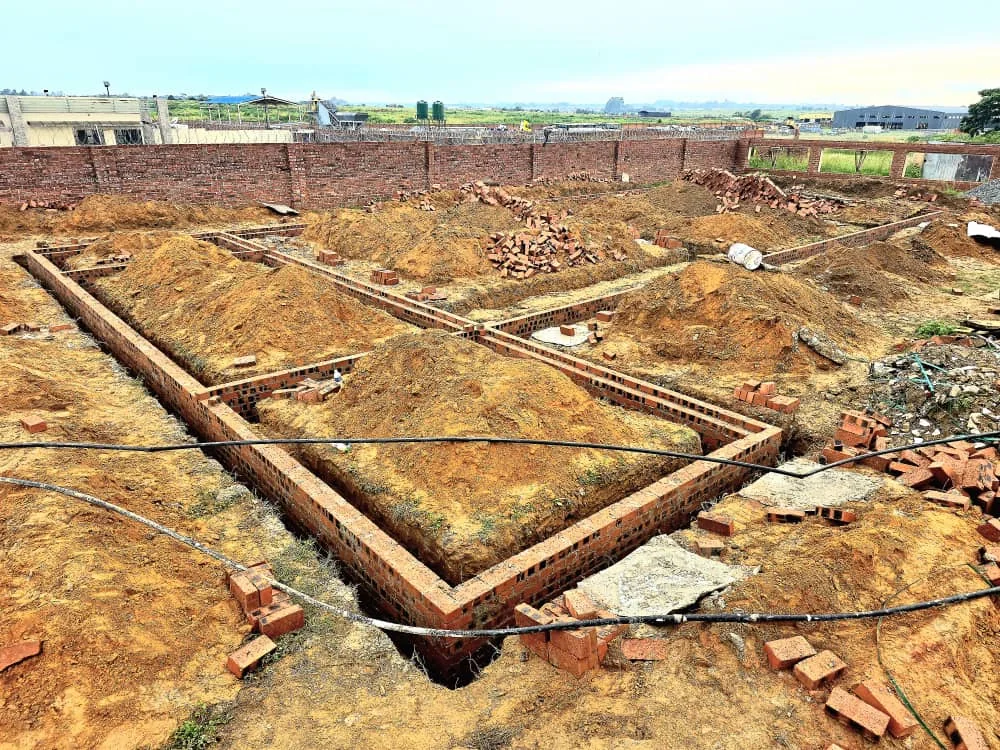 Upgrade offices
Setting out is the day the drawing meets the ground. Pegs go in, lines are strung between them, and from then on everything that is dug, poured or laid takes its position from those strings. It is also the day a building can go wrong for good.
What setting out is
The drawing gives every wall a dimension from a grid line, and every grid line a dimension from the boundary. Setting out turns those numbers into timber pegs and nylon line. We work from the surveyor's boundary beacons, fix one corner and one direction, and build the rest of the grid from there with a total station and a steel tape.
Beacons first, never the fence. Fences wander.
Profiles — the timber boards you see standing just outside the trenches — hold the lines clear of the digging, so the grid survives the excavator and can be strung again in a minute.
Profiles stand a metre clear of the trench.
What goes wrong
Almost never the instrument. It is a figure read from the wrong line of the drawing, a tape hooked on the wrong face of a peg, a 3 copied as an 8. Small, human and invisible: a string in the wrong place looks exactly like a string in the right one.
Commonest slip: measuring to the wall face instead of the grid line.
And the cost climbs with every day it goes unnoticed. Once the trench is dug it costs a day. Once the walls are up it is a conversation with the neighbour, the council and a lawyer.
Building lines and boundaries are law, not preference.
At peg stage a mistake costs ten minutes. Once the footing is cast, it costs the footing.
The second check
So nothing is dug on our sites until the setting out has been checked by someone who did not do it. They start from the drawing, not from the first person's notes, and they check it a different way: diagonals across every rectangle, overall dimensions rather than running ones, and the distance from each boundary measured on its own.
Diagonals equal within 5 mm, or it is set out again.
The check takes about an hour on a house and a morning on a larger building. Both people sign the setting-out sheet, and the sheet goes into the site file with a photograph of the pegs. If you are our client, you get a copy.
Signed sheet and photograph: site file, and the client.
What to ask your builder
Whoever builds for you, ask two things before the excavator arrives: who set this out, and who checked it? If the answer is the same name twice, ask for the diagonals. It is an hour of someone's time against the most expensive mistake a site can make.
And if you would like us to set out, or simply to check, a building that is about to start — send us the drawing.
N-12 · Drafted note, placeholder photograph · confirm before publishing
03In short
Inshort.
- 01
Set out from the beacons
Boundary beacons and the drawing's grid, never the fence.
- 02
Checked by a second person
From the drawing, a different way: diagonals, overalls, boundaries.
- 03
Signed before anything is dug
Both names on the sheet, a photograph of the pegs, a copy to you.
About to start on site? We will set it out, or check what has been set out.
Send us the drawing↗04Next note
N-11 · Cost · 5 min
What a quote
should
tell you.
Six lines to look for before you compare one builder's price with another's.